Do You Really Need 10 Products? Simplify Your Skincare
March 8, 2026 2026-03-08 22:38Do You Really Need 10 Products? Simplify Your Skincare

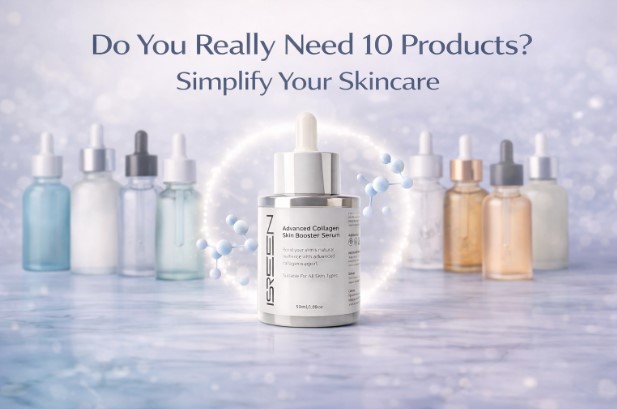
Do You Really Need 10 Products? Simplify Your Skincare
The 10-Step Trap
Open any beauty influencer’s page today and you’ll likely find a lineup that looks more like a chemistry lab than a bathroom shelf — toners, essences, serums, ampoules, exfoliants, SPF, oils, and more. The idea that more products equals better skin has been marketed aggressively for years, largely driven by the rise of elaborate Korean beauty routines.
But here’s the real question: do you actually need 10 products to get healthy, glowing skin?
The honest answer is no — and science backs that up.
At isreen.us, we believe that skincare should be effective, intentional, and accessible to every American household. In this guide, we’re breaking down what your skin genuinely needs, what’s just marketing noise, and how a streamlined routine can actually outperform an overwhelming product stack.
Why the “More Is More” Skincare Myth Took Over
The 10-step skincare routine became a cultural phenomenon around 2012, popularized by K-beauty brands entering the US market. And while many Korean skincare innovations are genuinely brilliant — think sheet masks, snail mucin, and centella asiatica — the number of steps was never the real secret.
The skin barrier is a delicate ecosystem. Overloading it with product after product — especially when ingredients aren’t chosen carefully — can cause congestion, irritation, and even accelerated skin aging. A 2023 report by the American Academy of Dermatology found that product overuse is now one of the top causes of “cosmetic dermatitis” in US adults, a condition where the skin becomes reactive and sensitized due to excessive topical exposure.
The beauty industry, however, profits from complexity. The more steps in your routine, the more products you buy. That’s a business model — not a skincare philosophy.
What Does Your Skin Actually Need?
Let’s strip it back to the fundamentals. Healthy skin, at its core, needs four things:
1. Cleansing — to remove dirt, excess oil, sunscreen, and pollutants without stripping the skin’s natural moisture barrier.
2. Hydration — to replenish water content and keep the skin plump, supple, and resilient.
3. Treatment — to address specific concerns like acne, hyperpigmentation, fine lines, or sensitivity with targeted, evidence-based ingredients.
4. Sun Protection — non-negotiable. UV exposure is responsible for up to 90% of visible skin aging, according to the Skin Cancer Foundation.
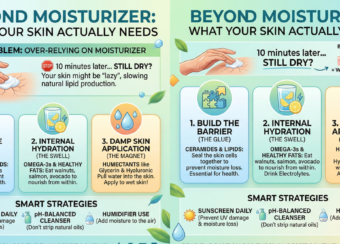
Notice what’s missing from this list? A separate toner, two serums, an ampoule, a facial mist, and a sleeping pack. For most people, a cleanser, moisturizer, targeted treatment, and SPF — that’s a complete, highly effective routine. That’s four steps, not ten.
The Problem With Layering Too Many Products
Adding more products doesn’t just waste money — it can actively work against your skin goals. Here’s why:
Ingredient Conflicts Are Real. Not all skincare actives play nicely together. For example, mixing vitamin C with niacinamide (a common pairing in multi-product routines) has been debated for years due to potential interactions that can reduce efficacy. Retinol and AHAs used together can cause severe irritation and compromise your skin barrier. The more products you layer, the higher the chance of creating a cocktail your skin can’t handle.
Your Skin Has a Limit. The epidermis (your skin’s outer layer) can only absorb a finite amount of product. After a certain point, additional layers sit on the surface, clog pores, or are simply wasted. Think of it like watering a plant — a set amount of water helps it thrive, but flooding it causes damage.
Sensitization Happens Gradually. Many people don’t realize their skin has become reactive over time until a full-blown breakout or rash appears. This sensitization often builds slowly as a result of over-exfoliation, too many active ingredients, or fragrance overload from multiple products.
Cost Adds Up Fast. The average American spends over $300 per month on skincare when following a 10+ step routine, according to a 2024 consumer survey by Statista. That’s over $3,600 a year — much of which is spent on products that provide minimal additional benefit over a well-chosen simple routine.
The Minimalist Skincare Routine That Actually Works
Here’s what an optimized, results-driven routine looks like — morning and night — with no wasted steps.
Morning Routine (3 Steps)
Step 1 — Cleanser: Use a gentle, pH-balanced cleanser suited to your skin type. For dry or sensitive skin, a hydrating cream cleanser is ideal. For oily or acne-prone skin, a foaming or salicylic acid cleanser works best. In the morning, many dermatologists actually recommend just rinsing with water if you cleansed properly the night before.
Step 2 — Moisturizer: Apply a lightweight moisturizer that supports your skin barrier. Look for ingredients like ceramides, hyaluronic acid, and glycerin. These aren’t trendy buzzwords — they’re well-studied actives with decades of clinical evidence.
Step 3 — SPF (Non-Negotiable): Apply a broad-spectrum SPF 30 or higher every single morning, rain or shine. In the USA, where UV exposure is significant year-round in southern states, this step does more for your skin’s long-term health than any $200 serum ever could.
Evening Routine (3 Steps)
Step 1 — Cleanser: A more thorough cleanse in the evening to remove makeup, SPF, pollutants, and sebum that accumulated throughout the day. Double cleansing (an oil cleanser followed by a gentle water-based cleanser) is actually a worthwhile two-step process if you wear heavy SPF or makeup.
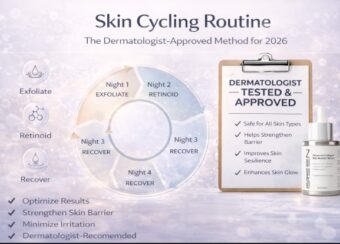
Step 2 — Treatment: This is where you address your specific skin concern. Retinol or retinoids for anti-aging and acne. Niacinamide for pores and hyperpigmentation. Azelaic acid for redness and rosacea. Vitamin C for brightening. The key is choosing one targeted treatment and using it consistently rather than layering five serums every night.
Step 3 — Moisturizer (or Night Cream): Seal everything in with a nourishing moisturizer. At night, you can afford a slightly richer formula since you’re not applying SPF over it.
That’s it. Six purposeful steps across the entire day — and your skin will thank you for the breathing room.
When Do Extra Products Actually Make Sense?
To be fair, a 10-step routine isn’t wrong for everyone. There are specific cases where additional products are genuinely warranted:
For targeted skin concerns: If you’re dealing with severe hyperpigmentation, active cystic acne, or rosacea, a dermatologist might recommend additional prescription-grade treatments alongside your basic routine. These are therapeutic additions, not random layering.
For self-care rituals: A weekly clay mask, a monthly chemical exfoliant, or a hydrating sheet mask can be wonderful additions to a wellness routine — they just don’t need to be daily staples.
For evolving seasonal needs: Your skin’s needs shift between summer and winter in the US. You might add a heavier balm or a humectant-rich serum in harsh Midwest winters, for example. Seasonal flexibility is smart; daily over-complexity is not.
The takeaway? Extra products should serve a specific, intentional purpose — not fill a shelf to feel like you’re “doing skincare right.”
How to Audit Your Current Routine
If you’re ready to simplify, here’s a practical way to evaluate what stays and what goes:
Step 1: Lay out every product you currently use. Yes, every single one.
Step 2: For each product, ask: What specific skin concern does this address? Does it contain a proven, evidence-based ingredient for that concern? Is it free from ingredients that conflict with others in my routine?
Step 3: Remove any product you can’t confidently answer those questions for. If you don’t know why something is in your routine, it probably shouldn’t be.
Step 4: Introduce products back one at a time. If you’ve had skin reactions in the past and aren’t sure what caused them, reintroducing products individually (and waiting 1–2 weeks between each addition) lets you identify the culprit.
The isreen.us Philosophy: Smarter, Not More
At isreen.us, every product in our line is designed with this principle at its core — do more with less. We formulate for the real lives of Americans who want results without the overwhelm, who value ingredient integrity over impressive-looking ingredient lists, and who believe their skincare routine should fit into their lifestyle rather than take it over.
Our products are:
Ingredient-honest — we tell you exactly what’s in each formula and why it’s there.
Dermatologist-friendly — designed with the input of licensed skin professionals practicing in the United States.
Barrier-first — because we understand that protecting your skin’s natural function is the foundation of every other result you want to achieve.
You don’t need a 10-product system. You need the right products — chosen intentionally, used consistently, and trusted to work.
Final Thoughts: Less Really Is More
The most effective skincare routine isn’t the longest one. It’s the one you’ll actually stick to, that includes ingredients your skin genuinely responds to, and that respects the intelligence of your skin barrier rather than overwhelming it.
So the next time you’re tempted by a 10-step haul, ask yourself: Is this for my skin, or for the algorithm?
Your skin already knows what it needs. Give it the right tools — not an entire hardware store.
Explore the isreen.us collection and build a routine that’s built for results, not complexity.