K-Beauty vs Western Skincare: What’s the Difference?
May 5, 2026 2026-05-05 17:01
K-Beauty vs Western Skincare: What’s the Difference?
Skincare has gone global—and two of the biggest influences shaping routines today are K-Beauty (Korean skincare) and Western skincare.
From 10-step routines to minimalist regimens, these two approaches often feel completely different.
But which one is better?
👉 The answer isn’t that simple.
Let’s break down the real differences, philosophies, ingredients, and results—so you can choose what actually works for your skin.
What Is K-Beauty?
K-Beauty refers to skincare products and routines developed in South Korea.
It’s known for:
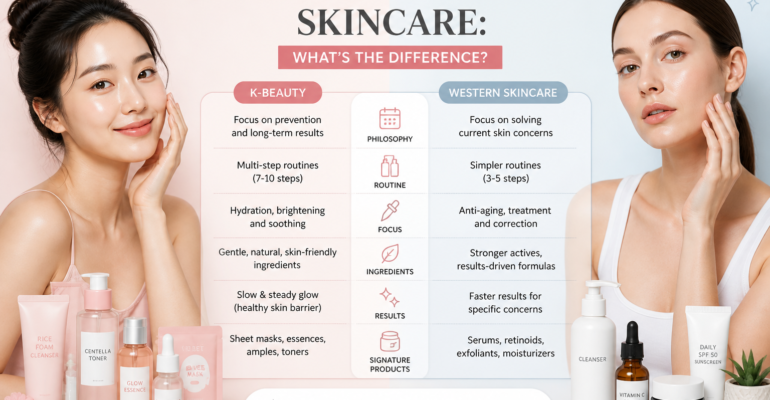
- Multi-step routines (often 7–10 steps)
- Focus on hydration and prevention
- Gentle, skin-first philosophy
Core Idea:
👉 Healthy skin = beautiful skin
Instead of fixing problems later, K-Beauty focuses on:
- Preventing damage
- Maintaining hydration
- Supporting the skin barrier
What Is Western Skincare?
Western skincare (mainly U.S. and Europe) takes a more results-driven, clinical approach.
It focuses on:
- Active ingredients
- Targeted treatments
- Faster visible results
Core Idea:
👉 Treat the problem directly
Western skincare is often built around:
- Anti-aging
- Acne treatment
- Corrective solutions
Key Differences Between K-Beauty and Western Skincare
1. Philosophy
| K-Beauty | Western Skincare |
|---|---|
| Prevention | Correction |
| Gentle care | Strong actives |
| Long-term health | Quick results |
2. Routine Style
K-Beauty:
- Multi-step (cleanser, toner, essence, serum, ampoule, cream, SPF)
- Layering lightweight products
Western:
- Minimal steps (cleanser, serum, moisturizer, SPF)
- Focus on fewer, stronger products
3. Ingredients
K-Beauty Popular Ingredients:
- Snail mucin
- Centella asiatica
- Rice extract
- Fermented ingredients
Western Popular Ingredients:
- Retinol
- Vitamin C
- AHAs/BHAs
- Niacinamide
4. Skin Barrier Approach
K-Beauty prioritizes:
👉 Hydration + barrier protection
Western skincare often:
👉 Uses strong actives that can sometimes damage the barrier if overused
5. Results Timeline
| Approach | Results |
|---|---|
| K-Beauty | Gradual, long-term |
| Western | Faster, more aggressive |
Pros and Cons
✔ K-Beauty Pros:
- Gentle on skin
- Great for sensitive skin
- Focuses on hydration and glow
❌ K-Beauty Cons:
- Time-consuming
- Results can take longer
- Too many steps for some people
Western Skincare Pros:
- Faster visible results
- Clinically backed ingredients
- Simple routines
Western Skincare Cons:
- Can irritate skin
- Risk of over-exfoliation
- Barrier damage if misused
Which One Works Better?
Here’s the truth:
👉 Both work—but for different goals.
Choose K-Beauty if:
- You want glowing, hydrated skin
- You have sensitive skin
- You prefer gentle routines
Choose Western Skincare if:
- You want faster results
- You’re targeting acne or aging
- You prefer simple routines
The Smartest Approach (What Experts Recommend)
✨ The best routine today is a hybrid approach
Combine:
- K-Beauty hydration + barrier care
- Western active ingredients
Example Routine:
Morning:
- Gentle cleanser
- Hydrating toner/essence (K-Beauty style)
- Vitamin C serum (Western)
- Moisturizer
- SPF
Night:
- Cleanser
- Hydration layer
- Treatment (retinol or niacinamide)
- Moisturizer
👉 This gives you the best of both worlds.
Why U.S. Consumers Are Mixing Both
In the U.S., skincare trends are evolving:
- People want results + skin health
- Minimal routines with maximum benefit
- Less irritation, more balance
That’s why hybrid skincare is becoming the new standard.
Where Isreen Fits In
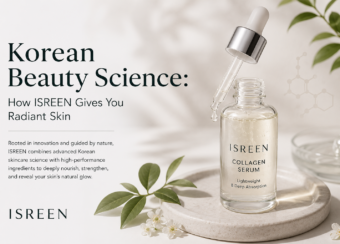
At Isreen, we follow a modern global approach:
✨ Inspired by K-Beauty hydration philosophy
✨ Powered by Western clinical ingredients
Our formulations focus on:
- Skin barrier repair
- Deep hydration
- Long-term results
Because skincare shouldn’t be about choosing sides—
👉 It should be about choosing what works.
Final Thoughts
K-Beauty and Western skincare aren’t competitors—they’re complements.
One focuses on prevention.
The other focuses on correction.
But when combined thoughtfully, they create something better:
Healthy, balanced, and radiant skin
Because the future of skincare isn’t one approach—
👉 It’s the right combination of both.