Clean Beauty vs. Science-Backed Beauty: Do You Have to Choose?
September 24, 2026 2026-09-24 12:16Clean Beauty vs. Science-Backed Beauty: Do You Have to Choose?

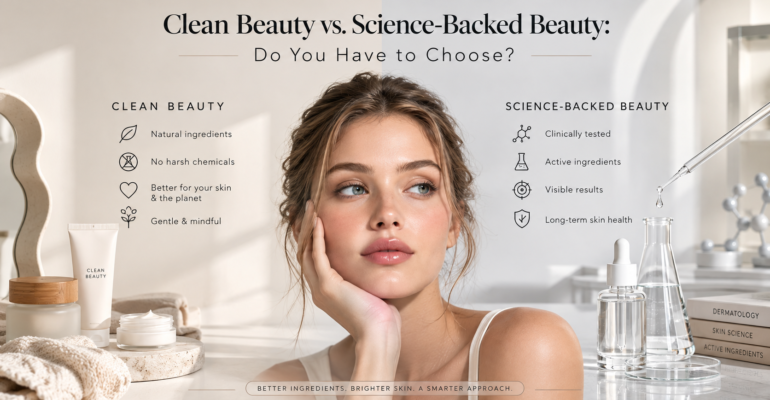
Clean Beauty vs. Science-Backed Beauty: Do You Have to Choose?
Walk into almost any beauty store today and you will see two ideas competing for attention: “clean beauty” and “science-backed skincare.”
One may emphasize simple formulas, naturally derived ingredients, or a carefully selected ingredient list. The other may highlight research, cosmetic chemistry, testing, and evidence.
But do you really have to choose one?
Not at all.
In reality, “clean” and “science-backed” describe different aspects of skincare. One is often used to communicate an approach to ingredients and formulation, while the other generally refers to using scientific knowledge and evidence when developing or evaluating products.
The better question is not “Which side is better?”
It is:
“How can I choose skincare that is thoughtfully formulated, safe to use, and appropriate for my skin?”
What Does “Clean Beauty” Actually Mean?
The first thing to understand is that “clean beauty” does not have one universally accepted scientific or regulatory definition in the United States.
The FDA has not established a formal regulatory definition for “natural” in cosmetic labeling, and the source of an ingredient does not automatically determine whether it is safe.
Different brands may use “clean” to describe different philosophies, such as:
- Avoiding certain ingredients
- Using naturally derived ingredients
- Focusing on simpler formulas
- Emphasizing ingredient transparency
- Choosing specific fragrance or preservative policies
- Prioritizing environmental or sourcing considerations
That means one brand’s definition of “clean” may not be identical to another’s.
So when you see the word clean, look beyond the marketing language and ask what the brand actually means by it.
What Is Science-Backed Skincare?
“Science-backed” generally refers to skincare choices informed by scientific research, cosmetic formulation principles, ingredient data, testing, and evidence.
That does not necessarily mean every product has undergone a large clinical trial.
For cosmetics in the United States, companies are responsible for ensuring their products are safe under labeled or customary conditions of use and for maintaining adequate safety substantiation. FDA notes that companies can use existing safety data and other scientifically sound methods to support product safety.
Scientific thinking can be relevant at several levels:
Ingredient science: What is known about an ingredient and how it is used in cosmetics?
Formulation science: How do the ingredients work together in the finished product?
Safety: Is the product appropriate for its intended use?
Product testing: Does the finished formula perform as intended for its cosmetic purpose?
This is much more useful than judging a product solely by whether its ingredient names sound familiar or natural.
Does Natural Mean Safer?
This is one of the biggest misconceptions in skincare.
Natural does not automatically mean safer, and synthetic does not automatically mean harmful.
Plants can contain compounds that cause irritation or allergic reactions, just as ingredients produced through other methods can be safe and useful in properly formulated cosmetics.
The FDA specifically notes that the source of an ingredient does not determine its safety and that “natural” ingredients are not automatically safer than ingredients from other sources.
So instead of asking:
“Is this ingredient natural?”
a better question is:
“Is this ingredient appropriate and well-formulated for its intended cosmetic use?”
Does “Chemical-Free” Make Sense?
You’ll sometimes see beauty marketing that suggests a product is “chemical-free.”
From a scientific perspective, that phrase is misleading.
Everything is made of chemicals, including water and naturally occurring substances.
What consumers generally mean when they say they want “chemical-free” skincare is that they want to avoid specific ingredients or categories of ingredients.
That is a completely reasonable personal preference—but it is much more useful to identify what you actually want to avoid rather than treating “chemical” as a synonym for “unsafe.”
Can Clean Beauty Be Science-Backed?
Absolutely.
A product can use naturally derived ingredients while also being thoughtfully formulated and supported by appropriate safety information and cosmetic science.
For example, a brand may choose plant-derived ingredients while using modern formulation techniques to improve stability, texture, preservation, and overall product performance.
There is no scientific rule saying that a formula must choose between nature and science.
Nature can provide ingredients. Science helps us understand, formulate, test, and use them responsibly.
Can Synthetic Ingredients Be Part of Good Skincare?
Yes.
A synthetic ingredient is not automatically a problematic ingredient.
Cosmetic chemists use many different types of ingredients because each can perform a specific function in a formula.
An ingredient might help with:
- Hydration
- Texture
- Skin conditioning
- Preservation
- Stability
- Product consistency
- Appearance
- Sensory experience
Sometimes a carefully selected synthetic ingredient can provide properties that are difficult to achieve consistently with a naturally sourced alternative.
The objective of a good cosmetic formula is not simply to maximize “natural” ingredients.
It is to create a product that is appropriate, stable, safe, and enjoyable to use.
What Should You Look for Instead of the “Clean vs. Science” Debate?
Rather than choosing a beauty philosophy based solely on a label, look at the product as a whole.
Read the Ingredient List
The ingredient list can tell you much more than a front-label buzzword.
Learn to recognize ingredients that matter to your personal skincare goals and ingredients you already know your skin does not tolerate.
Under U.S. cosmetic labeling rules, ingredients are generally listed in descending order of predominance, with certain exceptions for ingredients present at 1% or less and color additives.
Look for Meaningful Product Information
A trustworthy brand should make it reasonably clear what the product is, how to use it, and what consumers can expect from it.
Be cautious about dramatic claims that sound more like medical promises than cosmetic benefits.
FDA explains that cosmetic claims must be truthful and not misleading, and claims that a product treats or prevents disease or affects the structure or function of the body can cause the product to be regulated as a drug instead of simply a cosmetic.
Consider the Entire Formula
One trendy ingredient rarely tells the whole story.
A formula is a combination of ingredients that need to work together. Two products containing the same headline ingredient can feel and perform differently because the rest of their formulas differ.
Think About Your Own Skin
The “best” ingredient on the internet is not necessarily the best ingredient for you.
Your skin type, preferences, tolerance, routine, and environment all matter.
A beautifully formulated product is still not the right product if you don’t enjoy using it or your skin doesn’t tolerate it.
What About Preservatives?
Preservatives sometimes receive a negative reputation in clean beauty conversations.
But preservation can be an important part of cosmetic formulation.
Many products contain water and other ingredients that can support microbial growth if a formula is not adequately protected. FDA notes that cosmetic manufacturers are responsible for ensuring products are safe under customary conditions of use and emphasizes the importance of protecting cosmetics from harmful microbial contamination.
A preservative is not automatically a sign of a “bad” product.
In many formulations, it can be an essential part of maintaining product quality and safety.
Is “Clean” More Important Than “Effective”?
It depends on what “clean” means to you.
If your definition involves avoiding certain ingredients for personal reasons, that preference is valid.
But a marketing category alone cannot tell you whether a particular product will be suitable for your skin.
Instead, consider several questions:
Does the formula make sense?
Are the ingredients appropriate for the product’s purpose?
Is the product made with appropriate safety considerations?
Does it fit your skin and routine?
Are the brand’s claims clear and reasonable?
Those questions can tell you much more than a single word on a package.
What Does This Mean for ISREEN?
At ISREEN, skincare can be approached from a perspective that values both thoughtful ingredients and modern formulation.
A product does not have to fit neatly into a “clean” or “clinical” category to be worth considering.
What matters is the overall formula, the quality of the ingredients, how the product is designed to be used, and whether it fits into a practical skincare routine.
For consumers, this is good news.
You don’t need to pick a side.
You can appreciate ingredients inspired by nature while also recognizing the role of cosmetic science, formulation, testing, and evidence.
The Best Skincare Is About More Than a Label
Beauty trends often encourage us to choose teams:
Natural vs. synthetic.
Clean vs. conventional.
Traditional vs. scientific.
But skincare does not have to be that simple.
Modern cosmetic formulation can draw from many sources. A thoughtfully formulated product may contain ingredients from different origins and still be designed with safety, performance, stability, and user experience in mind.
The goal should not be to find the product with the most impressive marketing vocabulary.
The goal is to find products that make sense for your skin and that you can use consistently and confidently.
Frequently Asked Questions
Is clean beauty scientifically regulated in the United States?
There is no single FDA regulatory definition for “clean beauty.” The FDA also has not established a formal definition for “natural” in cosmetic labeling. Individual brands may therefore use “clean” according to their own standards.
Is science-backed skincare better than clean beauty?
Not necessarily. The terms describe different things. “Science-backed” generally emphasizes scientific research, formulation principles, testing, and evidence, while “clean” may describe a brand’s ingredient-selection or formulation philosophy.
Are natural skincare ingredients safer than synthetic ingredients?
Not automatically. FDA states that an ingredient’s source does not determine its safety. Natural ingredients can also cause irritation or allergic reactions.
Does synthetic mean harmful in skincare?
No. “Synthetic” describes how an ingredient is produced or sourced; it does not by itself determine whether an ingredient is safe or appropriate for cosmetic use.
What should I look for when choosing clean beauty products?
Look beyond the word “clean.” Check the complete ingredient list, the brand’s specific ingredient standards, directions for use, and whether the product fits your skin and personal preferences.
Can a skincare product be both natural and science-backed?
Yes. Naturally derived ingredients can be incorporated into formulas developed using cosmetic chemistry, safety data, testing, and modern formulation techniques.
Are preservatives bad for your skin?
Not inherently. Preservatives can serve an important role in protecting certain cosmetic formulations from microbial contamination. The suitability of a formula depends on its ingredients, formulation, intended use, and individual skin tolerance.
Does a long ingredient list mean a product is bad?
No. A longer ingredient list does not automatically mean a product is less safe or less effective. Different ingredients can serve different roles in a formula, including hydration, texture, stability, preservation, and conditioning.
Should I avoid ingredients I cannot pronounce?
Not simply because they are difficult to pronounce. Many common cosmetic ingredients have technical names. Instead, learn what an ingredient does and whether it is appropriate for your skin.
Is “chemical-free” skincare possible?
No skincare product can literally be “chemical-free,” because all matter is composed of chemicals. When brands use this phrase, consumers should look at which specific ingredients the brand means to exclude.
Does FDA approve cosmetics before they are sold?
Generally, no. Most cosmetic products and ingredients do not require FDA premarket approval, with an important exception for most color additives. Companies are responsible for cosmetic safety and compliant labeling.
The Bottom Line
You don’t have to choose between clean beauty and science-backed beauty.
You can value thoughtfully selected ingredients while also valuing cosmetic science, appropriate safety practices, transparent labeling, and evidence.
The smartest approach is to look past the marketing label and evaluate the whole product.
At ISREEN, we believe skincare should be about informed choices—not unnecessary either-or decisions.
Nature and science don’t have to compete. They can work together to create thoughtful skincare.