Recombinant Collagen vs. Marine Collagen: What’s Actually in Your Serum?
September 28, 2026 2026-09-28 16:09Recombinant Collagen vs. Marine Collagen: What’s Actually in Your Serum?

Recombinant Collagen vs. Marine Collagen: What’s Actually in Your Serum?
“Collagen” on a label tells you almost nothing. It doesn’t say where the collagen came from, how it was processed, or whether your skin can actually use it. And the source matters — a lot. Bovine, marine, and recombinant collagen are three very different ingredients that happen to share one name, and the gap between them is where most of the real performance difference in a serum lives.
The Three Sources, Briefly
Bovine collagen comes from cow hide, tendon, and bone. It was the original cosmetic collagen source, but it carries a higher risk of immune sensitivity and doesn’t closely match human collagen structure.
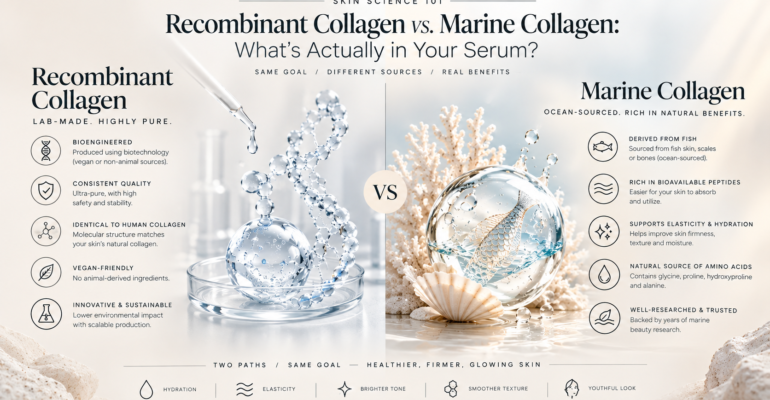
Marine collagen is extracted from fish skin, bone, and scale waste. It’s widely reported to trigger a lower immune response than mammalian sources, with reduced zoonotic risk, though this varies by species and processing method. It’s a step up from bovine, and it’s why marine collagen became the default “clean” claim in K-beauty for years. But it’s still an animal extract, and fish-derived type I collagen tends to have lower thermal stability and is specific to the species it came from — meaning consistency from batch to batch isn’t guaranteed. jcusupplysideshow
Recombinant collagen is where the science moved next. Instead of extracting collagen from an animal, it’s produced through biotechnology — a host organism like yeast or bacteria is engineered to produce collagen that closely matches what’s actually found in human skin. Nothing is harvested; it’s built. drsebagh
Why “Humanized” Is the Part That Matters
Not all recombinant collagen is created equal either. There’s a meaningful difference between a recombinant collagen-like protein and true recombinant humanized collagen.
A collagen-like protein is produced through genetic recombination but only approximates human collagen structure — modifications during that process can affect how well it performs and carry some risk of sensitization. Recombinant humanized collagen goes further: its gene sequence is aligned directly with human collagen, giving it strong tissue compatibility. Because the immune system recognizes it as a substance native to the body, it can move through the skin barrier and get absorbed directly, actively participating in the skin’s own collagen-building process. supplysideshowsupplysideshow
That distinction — humanized versus merely collagen-like — is the difference between an ingredient your skin has to tolerate and one it recognizes as its own.
Does the Research Back This Up?
Independent studies point the same direction. One study comparing recombinant human collagen to fish and bovine collagen found the recombinant version had a higher proportion of proline content and a greater average molecular weight. In lab tests on UV-damaged skin cells, the recombinant human collagen boosted cell proliferation to over 133% and increased cell migration more than threefold, while also cutting oxidative stress markers by over half — a meaningfully stronger protective response than the animal-derived versions it was tested against. doajdoaj
Separate industry research has echoed this: recombinant technologies using microbial and other expression systems have emerged specifically to produce human-like collagens with more tailored properties and better safety profiles than traditional animal or marine extraction.
What This Means for the Serum in Your Routine
None of this is to say marine collagen is a bad ingredient — it’s a real improvement over bovine sourcing and it’s still common for good reason. But if you’re comparing collagen serums and trying to figure out why formulas at similar price points perform differently, the source is often the answer hiding in plain sight.
This is exactly why the ISREEN Advanced Collagen Skin Booster Serum is built around Recombinant Humanized Collagen rather than a marine or bovine extract. Paired with Hyaluronic Acid for hydration and Niacinamide for barrier support, the formula is designed so the collagen component isn’t just present on the ingredient list — it’s structured to actually integrate with what your skin is already doing.
The Practical Takeaway
- Don’t take “collagen” at face value — check whether it’s marine, bovine, or recombinant, and if recombinant, whether it’s humanized.
- Molecular compatibility isn’t a marketing detail — it’s the mechanism that determines whether an ingredient penetrates and integrates, or just sits on the surface.
- Pair collagen-support ingredients with barrier-reinforcing ones (like Niacinamide) rather than relying on collagen alone.
- Judge results over weeks, not days — collagen support is a cumulative process, not an overnight one.
The next generation of collagen skincare isn’t about more collagen. It’s about collagen your skin actually recognizes.