How to Read a Skincare Ingredient List Without Being a Chemist
September 23, 2026 2026-09-23 18:09How to Read a Skincare Ingredient List Without Being a Chemist

How to Read a Skincare Ingredient List Without Being a Chemist
Ever picked up a skincare product, turned it around, and found yourself staring at a long list of ingredients you can barely pronounce?
You’re not alone.
Skincare ingredient lists can look complicated, but you don’t need a chemistry degree to understand the basics. Learning how to read an ingredient label can help you make more informed choices, compare products, and build a routine that makes sense for your skin.
The key is to stop trying to understand every word at once.
Instead, learn what to look for, where to look, and how to put the information together.
What Is an Ingredient List?
A skincare ingredient list tells you which ingredients are used in a cosmetic product.
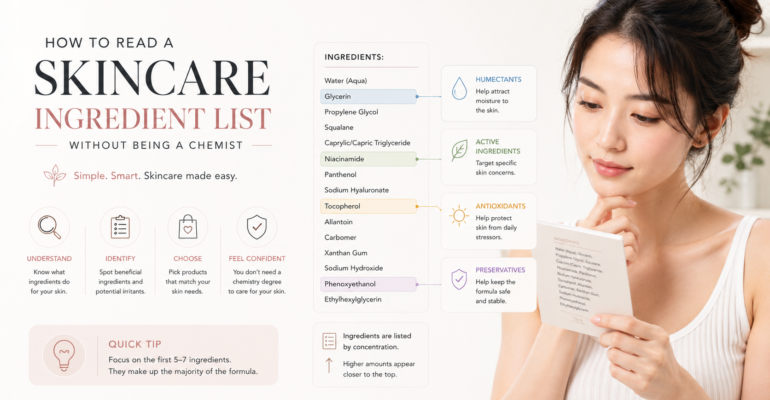
In the United States, cosmetic ingredient labeling follows specific requirements established by the U.S. Food and Drug Administration (FDA). Ingredients are generally listed in descending order of predominance, with some exceptions for ingredients present at lower concentrations.
That means the first several ingredients can give you useful clues about the product’s basic formulation.
But there is an important detail:
The ingredient list is not a ranking of which ingredients are “best.”
An ingredient appearing near the end of the list is not automatically ineffective, and an ingredient near the beginning is not automatically better for your skin.
Start With the First Few Ingredients
When you first look at an ingredient list, don’t try to decode everything.
Start with the first five to ten ingredients.
These often tell you a lot about the product’s overall base.
You may see ingredients such as:
- Water (Aqua)
- Glycerin
- Butylene Glycol
- Propanediol
- Caprylic/Capric Triglyceride
- Various oils, emollients, or conditioning ingredients
These ingredients can contribute to the product’s texture, hydration, stability, and overall feel.
For example, glycerin is a commonly used humectant that helps attract and retain moisture at the skin’s surface.
The important takeaway is that not every ingredient is there to target a specific skincare concern. Many ingredients are included to make the formula functional, stable, pleasant to use, or comfortable on the skin.
Learn the Difference Between “Active” and Supporting Ingredients
People often assume that the ingredient they care about should be the first ingredient on the label.
That’s not necessarily true.
A skincare formula can contain ingredients that serve very different purposes.
Humectants
Humectants help attract water and are commonly used in hydrating products.
Examples include:
- Glycerin
- Hyaluronic acid
- Propanediol
- Sodium PCA
Emollients
Emollients help soften and smooth the skin and can contribute to a comfortable, silky texture.
Examples include certain plant oils, esters, and fatty alcohols.
Occlusives
Occlusive ingredients help reduce water loss from the skin’s surface.
Examples can include petrolatum, certain waxes, and oils.
Antioxidants
Ingredients such as vitamin C derivatives, vitamin E, and certain botanical extracts may be used in formulations designed around antioxidant benefits.
Skin-Conditioning Ingredients
Ingredients such as niacinamide, peptides, and various botanical ingredients are commonly used in cosmetic products to support the appearance and feel of the skin.
A good formula is usually a combination of different types of ingredients rather than one “miracle” ingredient.
What Does “Aqua” Mean?
If you’ve ever wondered why so many skincare products begin with Aqua, it simply means water.
Water is frequently used as the base of creams, cleansers, serums, and other cosmetic formulations.
Seeing water at the top of an ingredient list does not mean the product is low quality.
It simply means water is an important part of the formula.
Don’t Be Afraid of Long Chemical Names
One of the biggest mistakes people make when reading ingredient labels is assuming that a complicated name means an ingredient is harmful.
It doesn’t.
Many perfectly common cosmetic ingredients have technical or chemical names.
For example, you might see names that sound intimidating but are simply ingredients used for:
- Moisturizing
- Texture
- Preservation
- Stability
- Fragrance
- Conditioning
- Product consistency
A difficult-to-pronounce ingredient is not automatically a bad ingredient.
The same applies in reverse: an ingredient with a natural-sounding name is not automatically better for everyone.
“Natural” and “synthetic” describe how an ingredient is sourced or produced; they do not, by themselves, determine whether a product will work well for your individual skin.
What About Fragrance?
Fragrance is one ingredient category worth paying attention to if your skin is sensitive to fragranced products.
A product may contain fragrance components under terms such as fragrance or parfum, along with certain individual fragrance ingredients when required by labeling regulations.
If you’ve experienced irritation from fragranced skincare before, checking the ingredient list can help you make a more informed choice.
If a product causes persistent burning, itching, redness, or swelling, discontinue use and consider speaking with a dermatologist.
Preservatives Aren’t Automatically Bad
Another common misconception is that preservatives are something to avoid at all costs.
In reality, preservatives can play an important role in many water-based cosmetic products by helping protect the formulation from microbial contamination.
Without appropriate preservation, some products could become unsafe or deteriorate more quickly.
Common preservative ingredients can include compounds such as:
- Phenoxyethanol
- Sodium benzoate
- Potassium sorbate
The presence of a preservative does not automatically make a product unsuitable for your skin.
The finished formula, concentration, intended use, and individual tolerance all matter.
What Does “Paraben-Free” or “Fragrance-Free” Actually Tell You?
Marketing claims can provide useful information, but they don’t tell you everything about a product.
For example:
Paraben-free means the formulation does not use parabens as preservatives.
Fragrance-free generally means the product is formulated without added fragrance ingredients, although you should still read the complete ingredient list if you have specific sensitivities.
A product can be free from one ingredient category while containing many other ingredients that may or may not suit your skin.
That’s why the ingredient list is often more informative than focusing on one marketing claim on the front of the package.
How to Spot Ingredients You Already Know
You don’t need to memorize hundreds of ingredients.
Start by recognizing a handful of familiar ones.
For hydration
Look for:
- Glycerin
- Hyaluronic acid
- Sodium hyaluronate
- Panthenol
- Betaine
For the appearance of uneven tone
You may see:
- Niacinamide
- Vitamin C or vitamin C derivatives
- Licorice-derived ingredients
- Certain botanical extracts
For skin-conditioning and smoothing
You may see:
- Peptides
- Ceramides
- Fatty acids
- Plant oils
- Squalane
Remember that an ingredient’s presence on a label does not guarantee a particular result. The overall formulation and how your skin responds matter too.
Ingredient Order: What Does It Really Mean?
Ingredient order can provide clues, but it shouldn’t be overinterpreted.
Generally, ingredients are listed from highest to lowest concentration until the lower-concentration portion of the formula, subject to applicable labeling rules.
This means the first few ingredients are often present in larger amounts.
But you usually cannot determine the exact percentage of every ingredient simply by looking at the label.
For example, if niacinamide appears after several base ingredients, that doesn’t automatically mean the product contains “too little” niacinamide to be useful.
And if an ingredient appears first, that doesn’t automatically make it the most important ingredient for your skin.
Context matters.
Don’t Judge a Product by One Ingredient
This is perhaps the most important rule when reading skincare labels.
A skincare product is a formula, not a collection of individual ingredients competing against each other.
Two products can contain the same headline ingredient but feel completely different and perform differently on the skin because their overall formulations are different.
For example, two serums might both contain hyaluronic acid, but one may feel lightweight while another feels richer because of the other ingredients used in the formula.
Instead of asking:
“Does this product contain the ingredient I want?”
also ask:
“What else is in the formula, and does the overall product fit my skin and routine?”
How to Read an ISREEN Ingredient List
When looking at an ISREEN product, you can use the same simple process.
Step 1: Identify the product type
Is it a cleanser, toner, serum, moisturizer, or another product?
The purpose of the product gives you context for its ingredient list.
Step 2: Look at the first several ingredients
These can help you understand the product’s base and texture.
Step 3: Find the ingredients you’re interested in
For example, if you’re looking for hydration, look for ingredients such as hyaluronic acid, glycerin, or panthenol.
If you’re interested in a more even-looking complexion, you might look for ingredients such as niacinamide or vitamin C derivatives.
Step 4: Check for ingredients you personally avoid
If you know your skin doesn’t tolerate fragrance or a particular ingredient, look specifically for it on the label.
Step 5: Consider the whole formula
Don’t make your decision based on one ingredient alone.
A well-designed skincare product is about how the ingredients work together.
A Simple 30-Second Ingredient-List Method
The next time you pick up a skincare product, try this:
1. What is the product designed to do?
2. What are the first few ingredients?
3. Which familiar ingredients are included?
4. Are there ingredients you know your skin doesn’t tolerate?
5. Does the product fit with the rest of your routine?
That’s it.
You don’t need to understand every chemical name to become a smarter skincare shopper.
The Bottom Line
Reading a skincare ingredient list can seem intimidating, but it becomes much easier once you know what you’re looking for.
Don’t judge a product simply because an ingredient has a complicated name. Don’t assume that the first ingredient is automatically the most beneficial one. And don’t choose a product based on a single trendy ingredient.
Instead, look at the whole formula, understand the purpose of the product, and consider how it fits your individual skincare needs.
At ISREEN, we believe better skincare starts with better understanding. You don’t need to be a chemist to make thoughtful skincare choices—you just need to know how to read the label.
A Final Reminder
Ingredient lists are useful, but they cannot tell you everything about how a product will perform for you personally. Skin can react differently from person to person.
If you have known allergies, highly reactive skin, or a persistent skin concern, consider discussing skincare ingredients with a dermatologist or other qualified healthcare professional.