Fine Lines vs. Dehydration Lines: How to Tell theDifference
August 12, 2026 2026-08-12 19:57Fine Lines vs. Dehydration Lines: How to Tell theDifference

Fine Lines vs. Dehydration Lines: How to Tell theDifference
Have you ever looked closely in the mirror and noticed tiny lines around your eyes, forehead, or cheeks that seem more noticeable than usual? Before assuming they are signs of aging, there is another possibility: dehydration lines.
Dry, dehydrated skin can make the skin surface look creased, tight, and less smooth. The good news is that these temporary lines can often look softer when the skin receives enough hydration.
But how can you tell the difference between dehydration lines and true fine lines?
Understanding the difference can help you choose the right skincare approach instead of reaching for strong anti-aging products when your skin may simply need more moisture.
What Are Dehydration Lines?
Dehydration lines are small, shallow lines that appear when the skin does not have enough water. Unlike permanent wrinkles, they are often temporary and can become more visible when the skin is dry.
They may appear around:
- The eyes
- Forehead
- Cheeks
- Around the mouth
Dehydration lines can make skin look tired, rough, or less plump. They are particularly noticeable after cleansing, during colder or dry weather, after sun exposure, or when your skincare routine is not providing enough hydration.
The important point is that dehydration is about water content, not necessarily your skin’s age.
What Do True Fine Lines Look Like?
Fine lines are small creases that develop as part of the natural aging process. Over time, skin produces less collagen and elastin, while factors such as repeated facial movements, UV exposure, and environmental stress can contribute to changes in skin texture.
Unlike dehydration lines, true fine lines tend to remain visible even when the skin is well hydrated.
Common areas include:
- Around the eyes
- Forehead
- Between the eyebrows
- Around the mouth
Fine lines may initially be subtle. With time, they can become more defined and visible even when the skin is moisturized.
Dehydration Lines vs. Fine Lines: What’s the Difference?
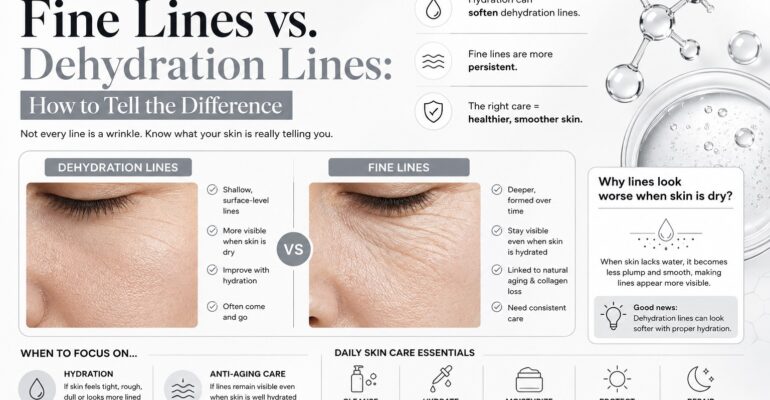
The easiest way to think about the difference is temporary vs. persistent.
Dehydration Lines
- Often appear suddenly
- Look more noticeable when skin feels dry
- Can improve after proper hydration
- May be accompanied by tightness or roughness
- Can fluctuate depending on your skincare routine and environment
Fine Lines
- Develop gradually
- Tend to remain visible when the skin is hydrated
- Become more noticeable with age and cumulative environmental exposure
- Are associated with changes in collagen, elastin, and skin structure
- Require consistent long-term skincare rather than hydration alone
Of course, real skin is not always this simple. A person can have both dehydration lines and genuine fine lines at the same time.
Why Do Lines Look More Visible When Skin Is Dry?
Think of hydrated skin as having a smoother, more supple surface.
When the outer layer of the skin becomes dehydrated, it can look rougher and less plump. Tiny surface creases may become more noticeable because the skin does not have the same smooth, hydrated appearance.
This is why you may wake up and suddenly feel like your fine lines look deeper than they did the day before.
It does not necessarily mean your skin aged overnight.
Sometimes, your skin simply needs water and moisture.
Can Hydration Temporarily Improve the Appearance of Lines?
Yes.
Applying hydrating skincare can help the skin look smoother and more plump, which may temporarily reduce the appearance of dehydration lines.
Ingredients such as hyaluronic acid are commonly used to support skin hydration by attracting and holding water. When properly incorporated into a skincare routine, hydrating ingredients can give the skin a softer, more supple appearance.
However, hydration does not permanently erase established fine lines.
This distinction is important:
Hydration can improve the appearance of dehydrated skin, while long-term anti-aging skincare focuses on supporting the skin’s overall structure and protecting it from further damage.
Hydration vs. Anti-Aging Care: What Does Your Skin Need?
The answer depends on what you are seeing and how your skin feels.
Focus on Hydration If:
Your skin feels:
- Tight after cleansing
- Rough or flaky
- Dull
- Less plump than usual
- More lined than normal when your skin is dry
Start with a gentle cleanser, hydrating serum, moisturizer, and daily sunscreen.
A serum containing hyaluronic acid can be particularly useful when your routine needs additional hydration.
Consider Anti-Aging Care If:
Your lines:
- Remain visible even when your skin is well hydrated
- Have gradually become more defined
- Are accompanied by changes in firmness or elasticity
- Are consistently noticeable rather than appearing only during periods of dryness
In this situation, hydration is still important, but you may also want to build a consistent long-term skincare routine focused on ingredients and habits that support healthy-looking, resilient skin.
Where Does Collagen Fit In?
Collagen is one of the major structural proteins in skin and contributes to its firmness and support.
As we age, natural collagen production gradually decreases. This is one reason skin can become less firm and fine lines can become more noticeable over time.
Topical collagen skincare can help condition and hydrate the skin’s surface, but it is important to have realistic expectations. A collagen serum should not be viewed as a way to replace the body’s natural collagen directly.
Instead, a well-formulated skincare routine can focus on hydration, skin conditioning, barrier support, antioxidant care, and sun protection.
This is where combining hydrating ingredients with a consistent skincare routine becomes more useful than relying on one ingredient alone.
How Hyaluronic Acid and Collagen Work Together
Hyaluronic acid and collagen have different roles in skincare.
Hyaluronic acid:
Helps support skin hydration and can make the skin feel softer and look more plump.
Collagen:
Is a structural protein naturally found in skin. In topical skincare, collagen-containing formulas are primarily used to condition and moisturize the skin.
Using both in a skincare routine can support a smoother, more hydrated-looking complexion.
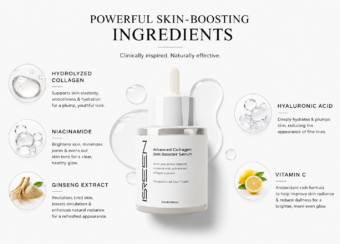
For example, ISREEN Advanced Collagen Serum combines recombinant humanized collagen with hyaluronic acid, niacinamide, vitamin C, and ginseng to support a hydrated, smoother-looking complexion.
A Simple Routine for Dehydrated, Textured Skin
You do not need a complicated 10-step routine to improve the look of dehydrated skin.
Morning
1. Gentle cleanse
Remove overnight buildup without stripping the skin.
2. Hydrating serum
Apply a hydrating serum to support a smoother, more supple appearance.
3. Moisturizer
Help maintain hydration and support the skin barrier.
4. Sunscreen
Use broad-spectrum SPF every morning. Sun protection is one of the most important steps for maintaining healthy-looking skin over time.
Evening
1. Cleanse
Remove sunscreen, makeup, and daily buildup.
2. Hydrating or collagen serum
Apply your serum according to your skin’s needs.
3. Moisturizer
Seal in hydration and help reduce moisture loss overnight.
Consistency matters more than constantly adding new products.
How to Tell What Your Skin Needs
Try observing your skin after applying a simple hydrating routine.
If the tiny lines become noticeably less visible when your skin is properly hydrated, dehydration may be contributing to their appearance.
If the lines remain consistently visible despite good hydration, they may be genuine fine lines.
This does not mean you need to choose between hydration and anti-aging care.
Healthy aging skincare should include both.
Hydrated skin generally looks smoother and more comfortable, while long-term care focuses on protecting the skin and supporting its appearance as it changes over time.
Don’t Forget Sun Protection
If fine lines are your concern, sunscreen should not be an afterthought.
UV exposure can contribute to premature visible skin aging, including changes in texture, firmness, and the appearance of fine lines.
A simple routine with daily broad-spectrum SPF can help protect your skin from ongoing environmental damage.
Your future skin will thank you for the consistency.
The Bottom Line
Not every line you see in the mirror is a wrinkle.
Dehydration lines are often temporary and can become less noticeable when the skin is properly hydrated. True fine lines are more persistent and are associated with natural changes in the skin over time.
The best approach is not to panic when you notice a few new lines. Start by assessing your skin’s hydration, simplify your routine if necessary, and give your skin consistent moisture and protection.
Ingredients such as hyaluronic acid and collagen can complement a skincare routine designed to support a smoother, hydrated-looking complexion, while daily sunscreen remains essential for long-term skin care.
When your skin is hydrated, protected, and consistently cared for, it can look healthier, smoother, and more radiant at every stage of life.
Frequently Asked Questions
1. How do I know if I have dehydration lines?
Dehydration lines are usually small and shallow and may become more noticeable when your skin feels tight, dry, or rough. They can appear less visible after your skin is properly hydrated.
2. Can dehydration lines turn into wrinkles?
Dehydration itself does not automatically turn a temporary line into a permanent wrinkle. However, chronic dryness and environmental factors can affect the overall appearance and condition of the skin, so maintaining hydration and protecting your skin is important.
3. Can hyaluronic acid reduce the appearance of dehydration lines?
Hyaluronic acid can help support skin hydration, which may temporarily make dehydration lines appear softer and the skin look more plump and smooth.
4. Does collagen serum remove fine lines?
A topical collagen serum should not be expected to permanently remove established fine lines. Collagen-containing skincare can help condition and moisturize the skin, while a complete routine should also include hydration, sun protection, and other appropriate skincare ingredients.
5. Should I use moisturizer if I have oily skin?
Yes. Oily skin can still become dehydrated. Choose a lightweight, non-greasy moisturizer that supports hydration without feeling heavy on the skin.
6. Can dehydration make wrinkles look worse?
Yes. When skin is dehydrated, existing fine lines and wrinkles can appear more pronounced because the skin surface may look less plump and smooth.
7. How long does it take for dehydrated skin to look better?
The appearance of dehydration can improve relatively quickly once you provide consistent hydration, although the exact timeline varies depending on your skin condition, routine, environment, and other factors.
8. Is hydration enough for aging skin?
Hydration is important, but it is only one part of an effective skincare routine. Aging skin also benefits from consistent sun protection, gentle cleansing, moisturization, and carefully selected ingredients that support healthy-looking skin.
Final Takeaway
If your lines disappear or soften when your skin is hydrated, dehydration may be part of the problem. If they remain visible, they may be true fine lines.
Either way, your skin does not need an overwhelming routine.
Start with the basics: hydrate, moisturize, protect, and stay consistent.
For skin that needs an extra boost of hydration and conditioning, a collagen serum with hyaluronic acid can be a simple addition to your routine.
FAQs
1. What are dehydration lines?
Dehydration lines are small, shallow lines that appear when the skin lacks water. They are often temporary and may look less noticeable after proper hydration.
2. How can I tell dehydration lines from fine lines?
Dehydration lines usually become more visible when your skin is dry and can improve with hydration. True fine lines tend to remain visible even when the skin is well hydrated.
3. Can dry skin make fine lines look worse?
Yes. When skin lacks hydration, it can look less plump and smooth, making existing fine lines appear deeper or more noticeable.
4. Can hyaluronic acid help with dehydration lines?
Yes. Hyaluronic acid helps attract and retain water, supporting a more hydrated, plump, and smoother-looking skin surface.
5. Can hydration permanently remove fine lines?
No. Hydration can temporarily soften the appearance of dehydration lines and make fine lines look less noticeable, but it cannot permanently erase established fine lines.
6. Should I focus on hydration or anti-aging skincare?
You don’t necessarily have to choose one. Hydration supports the skin’s appearance and comfort, while long-term anti-aging care focuses on maintaining healthy-looking skin and protecting it from environmental damage.
7. Can collagen serum help with fine lines?
A topical collagen serum can help moisturize and condition the skin, making it look smoother and more supple. It should not be expected to permanently replace or restore the skin’s natural collagen.