Azelaic Acid vs. Niacinamide: Which One Does Your Skin Actually Need?
September 20, 2026 2026-09-20 20:39Azelaic Acid vs. Niacinamide: Which One Does Your Skin Actually Need?

Azelaic Acid vs. Niacinamide: Which One Does Your Skin Actually Need?
Azelaic acid and niacinamide are two of the most versatile ingredients in modern skincare. Both can help improve uneven skin tone, calm the appearance of redness, and support healthier-looking skin — but they work in different ways.
If you’re comparing azelaic acid vs. niacinamide, the right choice depends on what your skin actually needs. Azelaic acid is more targeted toward acne, inflammation, and discoloration, while niacinamide is a gentler multitasker that supports the skin barrier, oil balance, and overall skin appearance.
What Does Azelaic Acid Do?
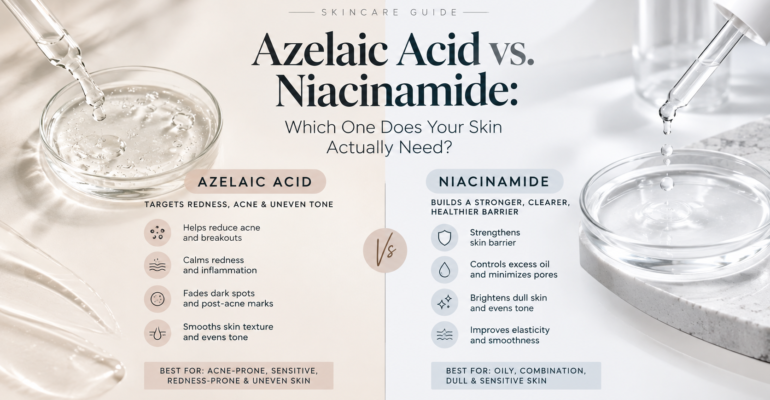
Azelaic acid is a naturally occurring dicarboxylic acid commonly used in skincare for acne, redness, and uneven pigmentation. It has anti-inflammatory and antimicrobial properties and is generally considered suitable for many sensitive skin types.
Azelaic acid can help:
- Reduce the appearance of redness and inflammation
- Support clearer-looking skin
- Improve the appearance of post-acne marks
- Even out an uneven-looking complexion
- Reduce the appearance of discoloration over time
It’s particularly useful if your main concerns are breakouts, redness, post-acne marks, or uneven pigmentation.
What Does Niacinamide Do?
Niacinamide is a form of vitamin B3 and one of the most widely used skincare ingredients for a reason: it’s versatile and generally well tolerated.
It can help support:
- The skin barrier
- A more balanced appearance of oiliness
- More even-looking skin tone
- Smoother-looking texture
- Hydration retention
- The appearance of enlarged pores
Unlike azelaic acid, niacinamide isn’t primarily a targeted acne or redness treatment. Think of it as a daily support ingredient that helps improve the overall condition and resilience of your skin.
Azelaic Acid vs. Niacinamide: What’s the Difference?
| Skin Concern | Azelaic Acid | Niacinamide |
|---|---|---|
| Redness | Excellent targeted option | Can help calm the appearance |
| Acne | Stronger targeted option | Can support oil balance |
| Post-acne marks | Helpful | Helpful |
| Uneven tone | Helpful | Helpful |
| Skin barrier | Supportive, but not its main role | Excellent |
| Oiliness | Some benefit | Excellent |
| Sensitive skin | Often suitable, but may cause irritation when introduced too quickly | Generally well tolerated |
| Daily use | Depends on formula and skin tolerance | Commonly suitable for daily use |
So, Which One Should You Choose?
If your biggest concern is active breakouts, visible redness, or post-acne discoloration, azelaic acid may be the more targeted choice.
If you’re dealing with oiliness, dull-looking skin, uneven texture, or a weakened skin barrier, niacinamide may be the easier place to start.
And you don’t necessarily have to choose just one.
Can You Use Azelaic Acid and Niacinamide Together?
Yes. Azelaic acid and niacinamide can generally be used in the same skincare routine.
They approach different skin concerns, making them a useful combination when your routine is built around your skin’s tolerance.
A simple routine could look like this:
Morning
- Gentle cleanser
- Niacinamide or niacinamide-based serum
- Moisturizer
- Broad-spectrum SPF 30+
Evening
- Cleanser
- Niacinamide-based serum
- Azelaic acid
- Moisturizer
If you’re new to azelaic acid, start slowly rather than applying it every night immediately. Using it a few times per week allows you to see how your skin responds.
Where Does a Collagen Serum Fit In?
Azelaic acid and niacinamide aren’t designed to do everything.
Azelaic acid is primarily a targeted ingredient for concerns such as acne, redness, and discoloration. Niacinamide focuses more on barrier support, oil balance, and overall skin quality.
For hydration and the appearance of firmness, a dedicated serum can complement both.
The ISREEN Advanced Collagen Skin Booster Serum combines Niacinamide, Hyaluronic Acid, and Recombinant Humanized Collagen in one formula. This makes it a convenient step for adding hydration and barrier-supportive ingredients while complementing a routine that includes targeted actives such as azelaic acid.
Rather than treating the serum as a replacement for azelaic acid, think of it as a supportive step: azelaic acid targets specific concerns, while a hydrating serum helps support the skin around your active treatments.
How to Add Azelaic Acid to Your Routine
If you’re introducing azelaic acid for the first time, keep the rest of your routine simple.
Step 1: Cleanse
Use a gentle cleanser without over-cleansing or scrubbing the skin.
Step 2: Hydrate
Apply your niacinamide-based serum, such as ISREEN Advanced Collagen Skin Booster Serum.
Step 3: Apply Azelaic Acid
Use your azelaic acid product according to its directions. Start with a lower frequency if your skin is sensitive or unfamiliar with the ingredient.
Step 4: Moisturize
Finish with a moisturizer to support your skin barrier.
Step 5: Wear Sunscreen
In the morning, always finish with broad-spectrum sunscreen. Sun protection is especially important when you’re working on uneven tone and post-acne discoloration.
The Bottom Line
Azelaic acid vs. niacinamide isn’t really a competition.
They have different strengths.
Choose azelaic acid when your routine needs a more targeted approach to breakouts, redness, or post-acne marks.
Choose niacinamide when you want a versatile daily ingredient for barrier support, oil balance, hydration retention, and overall skin appearance.
And if your routine needs both targeted treatment and hydration support, you can use the two together — as long as your skin tolerates the combination.
Frequently Asked Questions
Can I use azelaic acid and niacinamide together?
Yes. They are generally compatible and can be used in the same routine. Introduce azelaic acid gradually if you’re new to it.
Is azelaic acid stronger than niacinamide?
They aren’t directly comparable in strength because they serve different purposes. Azelaic acid is more targeted toward acne, redness, and discoloration, while niacinamide is a broader barrier-support ingredient.
Should I use niacinamide before azelaic acid?
If you’re using both as separate products, applying a lightweight niacinamide serum before azelaic acid is a practical routine. Always follow the directions of your specific products.
Can I use azelaic acid every day?
Some people can use azelaic acid daily, while others need to use it less frequently. Start gradually and adjust based on how your skin responds.
Does niacinamide help with dark spots?
Niacinamide can help improve the appearance of uneven skin tone and discoloration. For more targeted pigmentation concerns, it may be combined with other appropriate ingredients such as azelaic acid.
Can I use a collagen serum with azelaic acid?
Generally, yes. A hydrating, niacinamide-based collagen serum can complement an azelaic acid routine by providing ingredients focused on hydration and barrier support.